Olivia Kaplan
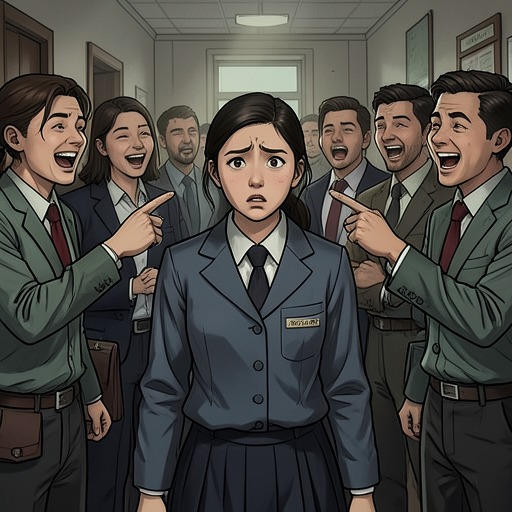
Luckiest Girl AliveOlivia Kaplan is a popular student at The Bradley School whose connection with TifAni FaNelli mixes social rivalry, moments of uneasy companionship, and a fatal shared experience. She dies in the cafeteria attack, but her story does not end with the immediate shock of that loss: TifAni’s memories preserve small details of Olivia’s habits and appearance, while later revelations recast a rumor Olivia spread as part of the chain of events preceding the attack.
Identity and Social Position
Olivia occupies a place of influence among the students, regularly holding court at lunch and moving within Dean Barton and Hilary’s circle. TifAni describes her as pretty in a way that adults might appreciate, but this description is filtered through TifAni’s own sharp, sometimes ungenerous perspective. She dwells on Olivia’s curly hair, which became frizzier when blow-dried, and on the flushed cheeks and visible blackheads she noticed when Olivia drank. TifAni also assumes that Liam Ross would not be attracted to Olivia without deliberate effort. These details reveal as much about the narrator’s competitive gaze as they do about Olivia’s appearance.
Olivia has a large, loft-like wing of her family’s house, with her bedroom separated from her younger sister’s by a bathroom. According to Hilary, the sister was the pretty one and the favorite, a comparison Hilary connected to Olivia barely eating. The account offers a possible context for Olivia’s troubled relationship with food, but it reaches the reader through another student’s report rather than Olivia’s own explanation.
Friendship, Rivalry, and the Party
Olivia’s relationship with TifAni shifts between inclusion and resentment. TifAni is tolerated at the lunch table, in part through her association with Hilary and Dean, but her presence does not mean she is secure in Olivia’s favor. Olivia appears bothered that TifAni attended Dean’s party without telling her and that TifAni hooked up with Liam, whom Olivia had made clear she wanted. When Olivia asks whether the encounter was fun, her bright manner and rapid blinking strike TifAni as a performance. TifAni answers uncertainly, and the exchange produces a genuine laugh, briefly loosening the rivalry without resolving it.
At Olivia’s house, TifAni finds her sitting cross-legged on the floor beside her bed. Bags of Swedish Fish candy and Starbursts, vodka, and an overturned bottle of Diet Coke surround her. The girls drink vodka with Diet Coke and eat the candy as the light fades, leaving the room dark. The scene places Olivia’s apparent ease as a host beside the risks and disorder of the setting; it also links her social life to the drinking and sexual competition that shape TifAni’s memories of adolescence.
Food, Habit, and Vulnerability
Olivia’s eating is presented through contrasting details rather than through an account of her inner life. Hilary associates her thinness with comparison to her younger sister, while TifAni later sees Olivia surrounded by sweets and alcohol. At school, Olivia performs a more controlled ritual with a Swedish Fish candy: she tears it apart at the tail, rolls the pieces into small balls, and eats them. TifAni finds her doing this at her usual lunch seat after trying and failing to locate her elsewhere.
That lunchtime, TifAni notices a half-moon bruise at the right corner of Olivia’s mouth. Her first reaction is entangled with her own fear that Olivia’s anger toward her will end the friendship. She admits that, at fourteen, she is more immediately distressed by the bruise’s consequence for herself than by the possibility that Olivia has been hurt at home. The bruise is evidence of vulnerability, but the narrative does not establish who caused it. TifAni’s account instead exposes the self-absorption through which she initially sees it.
Death and the Image of Green Nails
During the cafeteria attack, smoke blocks the route TifAni and Teddy would normally use to leave. They turn and climb toward the Brenner Baulkin Room. In TifAni’s recollection, Olivia lies beside Hilary; unlike Hilary, who calls for her mother, Olivia asks for no one. TifAni states plainly that Olivia is dead. The contrast in their responses gives the scene its terrible stillness: the room gathers students from different years and social positions, while Olivia’s silence marks the irreversible loss among them.
Later, as TifAni is questioned by Detective Dixon, she remembers Olivia from chemistry class, hunched over her desk and writing furiously, with green nail polish on her fingers. She wonders whether the polish could remain after death, imagining the color as the last trace of Olivia. The thought is not a report of what physically survived; it is a way TifAni’s mind fixes on a small, ordinary detail while she struggles to answer questions about the past. Green nails return her to a living Olivia and make her absence feel concrete.
Rumor and Retrospective Significance
Olivia’s role in the history of the attack becomes more complicated when TifAni later reads Arthur’s diaries and police reports. A story Olivia claimed to have witnessed at The Spot—that Arthur performed oral sex on Ben Hunter—was false. The rumor hurt and angered Ben, and Arthur exploited it, invoking Olivia while cultivating Ben’s participation in a planned attack. The later account does not make Olivia responsible for Arthur’s violence; it shows how a piece of teenage gossip could be seized and turned to darker purposes by someone with a larger, murderous plan.
Olivia therefore remains present in two sharply different forms: as TifAni’s classmate, remembered through candy, a bruise, and green nail polish, and as a name entangled in the misinformation Arthur used to manipulate Ben. Her death binds those private recollections to the school’s catastrophe. Through TifAni’s shifting memories, Olivia is neither reduced to the rumor nor separated from the harm it helped set in motion.